
Common Pool Heat Pump Problems and How to Fix Them
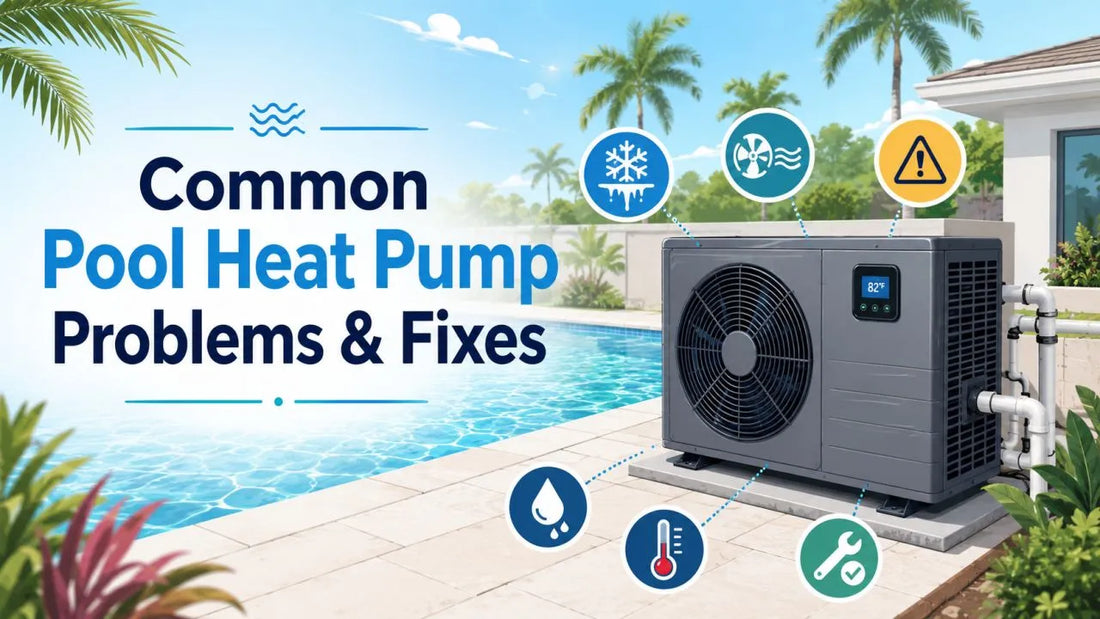
Most pool heat pump problems come down to five things: power, water flow, airflow, outdoor air temperature, and expectations about heating speed. Four of the five you can check yourself in about ten minutes, with no tools and no service call.
Below is what each common fault looks like on the panel, and what to try before booking a repair.
What causes most pool heat pump problems?
Most pool heat pump problems are caused by restricted water flow, blocked airflow across the evaporator coil, outdoor air that is too cold for the unit to extract heat from, a tripped breaker or failed capacitor, or a heater that is undersized for the pool it serves.
Actual component failure is less common than owners assume. Run this triage first:
-
Confirm the filter pump is running and water is moving through the heater.
-
Check the dedicated breaker and the on/off switch on the unit.
-
Set the thermostat at least 2°F above current water temperature.
-
Read the code on the display and write it down before it clears.
-
Walk around the unit and look for anything blocking the coil or fan discharge.
Pool heat pump not turning on? Start with power and the thermostat
A pool heat pump that will not start usually has a power or setpoint issue rather than a failed compressor. Check the dedicated breaker, the switch on the unit, and the thermostat. A heater set at or below current water temperature sits idle by design and shows no fault.
Try these in order:
-
Switch the heater and breaker fully off, wait five minutes, then restore power. This clears many latched control faults. Inverter models may need longer.
-
Confirm the thermostat is set above current water temperature. Many panels show "LO" or nothing at all when there is no call for heat.
-
Check whether a timer, automation schedule or app setting is holding the unit in standby.
-
Look at the capacitor for bulging, cracking or oily residue, which points to a failed start capacitor.
Leave these to a licensed technician:
-
Anything inside the electrical panel while power is live
-
Suspected wiring faults, corroded lugs or voltage drop
-
Capacitor replacement, since capacitors hold a charge after power is cut
Why is my pool heat pump running but not heating?
A unit that runs without heating almost always has a water flow or airflow restriction. Low flow from a dirty filter, a closed valve or a slow variable-speed pump triggers FLO or PS codes. A fouled evaporator coil starves the refrigerant circuit of the warm air it needs to move heat.
Signs your problem is water flow:
-
FLO, PS or E03 codes appearing and clearing on their own
-
The heater cycling off within minutes of starting
-
Weak return jets or a water line below the middle of the skimmer
-
A filter pressure gauge well above its clean starting pressure
Restore flow in this order:
-
Clean or backwash the filter, then empty the pump and skimmer baskets.
-
Top the pool up to the middle of the skimmer opening.
-
Confirm every valve is open and any heater bypass is fully closed.
-
If you run a variable-speed pump, raise the RPM. Low-speed filtration settings often fall below the minimum flow a heat pump needs, a frequent cause of intermittent FLO codes on newer setups.
-
Match the heater schedule to the pump schedule. A code that appears at the same time daily means the pump is shutting off first.
Air matters as much as water. AHRI notes that typical pool heat pump COP values sit between 4.0 and 6.0, and that the electricity feeding the unit converts to only around 14,000 BTU. Nearly all usable heat comes from passing air, which is why a dirty coil cuts output immediately.
How do I fix airflow and coil problems?
Keep the manufacturer's minimum clearance around the unit, rinse the evaporator coil gently from the inside out with a garden hose, and leave the fan discharge clear. Restricted airflow shows up as LP codes, weak heat output, or frost across the coil face.
Common airflow blockers:
-
Cottonwood, grass clippings and pollen matted into the coil fins
-
Shrubs, fence panels or an AC condenser crowding the intake
-
A roof overhang pushing cold discharge air back into the intake
-
A winter cover or tarp left on the cabinet while the unit runs
To clean the coil safely:
-
Cut power at the breaker.
-
Remove loose debris by hand or with a shop vacuum. Never push tools between the fins, which bend and permanently reduce airflow.
-
Rinse with a garden hose at low pressure, spraying from inside the cabinet outward.
-
Trim vegetation back, clear the discharge path, then restore power.
Frost across the coil is usually an ambient temperature issue, not a defect. Switch the unit off at the breaker, let it melt fully, then restart.
Is my pool heat pump leaking, or is that condensation?
Most suspected leaks are condensation. A running heat pump can shed several gallons of water an hour on humid days as warm air cools against the coil. Test the puddle with a chlorine test strip: pool water reacts, condensate does not.
-
Note whether water appears only while the unit runs. Condensation stops shortly after the compressor does.
-
Dip a chlorine test strip in the puddle. No reaction means condensate, and no repair is needed.
-
If the strip reacts, shut the heater down, keep water circulating, and call a technician. A leaking heat exchanger is not a DIY repair.
-
Confirm the unit sits level with a clear condensate drain path underneath.
Why won't my pool reach the set temperature?
If the heater runs normally but the water stalls a few degrees short, the cause is usually heat loss, not a fault. Evaporation is the largest source of pool energy loss, so an uncovered pool in wind and cool nights sheds heat nearly as fast as the unit adds it.
The U.S. Department of Energy states the range plainly: heat pump pool heaters work efficiently as long as outside temperature stays above roughly 45°F to 50°F, and cooler intake air means lower efficiency. Below that, your unit is not broken. It is outside its operating envelope.
Covers change the arithmetic more than any other single fix. DOE cost tables show a 1,000 square foot outdoor pool held at 80°F in Miami costing roughly $1,989 a year uncovered, against about $409 with a cover. EPA WaterSense at Work rates cover effectiveness at up to 95% for solid, mesh and hybrid covers, 50% to 95% for solar and bubble covers, and around 15% for liquid suppressants.
Mistakes that keep water stubbornly cool:
-
Leaving the pool uncovered overnight, when the temperature gap is widest
-
Running a summer-sized heater into shoulder-season weather
-
Expecting fast recovery. AHRI is explicit that heat pumps maintain a temperature rather than deliver instant heat
-
Short filtration cycles, which limit the hours the heater can work
-
Chasing large setpoint jumps instead of holding one steady temperature
What do common pool heat pump error codes mean?
Codes vary by brand, so your manual is the final word. These patterns hold across most residential units:
-
FLO, PS, E03: insufficient water flow. Check pump, filter, valves, and pump speed.
-
HP, HI, HP5: high refrigerant pressure, usually from restricted water flow or unusually warm incoming water.
-
LP, LP5: low refrigerant pressure, usually from blocked airflow, a dirty coil, cold ambient air or a failed fan motor.
-
dEF, FS: a normal defrost cycle, not a fault.
-
Sensor codes such as P01 to P09, SH or SF: a probe fault needing a technician.
If a pressure lockout returns after one reset, stop. Repeatedly resetting a pressure fault risks compressor damage, the most expensive repair on the unit.
How to prevent most pool heat pump problems?
Keep the coil clean, the airflow clear, the water chemistry balanced, and the filter maintained. DOE recommends an annual tune-up and notes that with proper installation and maintenance, heat pump pool heaters can last 10 or more years.
A practical maintenance routine:
-
Rinse the coil and clear debris from the cabinet monthly during the season.
-
Trim plants back to the clearance distance in your installation manual.
-
Redirect lawn sprinklers away from the unit. AHRI warns that overspray causes corrosion.
-
Fit a gutter or diverter if the unit sits under a roof edge.
-
Keep pH and chlorine in range. Both attack the heat exchanger from the inside.
-
Check that condensate drains freely from the pad.
-
Book a professional service before each season.
Two rules with no exceptions: never cover the cabinet while the unit runs, and never operate a heat pump if any part has been submerged.
When should you stop troubleshooting and call a technician?
Book a professional when any of these apply:
-
The same code returns after two full power cycles
-
The breaker trips repeatedly
-
A chlorine test strip confirms pool water is escaping the unit
-
Ice forms on the coil in mild weather
-
The compressor hums but will not start
-
The fault involves refrigerant, which requires EPA certification to handle legally
One Warning: working on internal components can void your warranty. If the unit is still covered, call the manufacturer first. It costs nothing and often resolves things faster.
FAQs
Why is my pool heat pump not heating?
The two most common causes are low water flow and restricted airflow. Clean the filter, empty the baskets, open all valves, raise variable-speed pump RPM, then clear debris from the evaporator coil. If the outside air is below roughly 50°F, the unit will produce little usable heat regardless of condition.
What temperature is too cold for a pool heat pump?
DOE states that heat pump pool heaters work efficiently as long as outside temperature stays above about 45°F to 50°F. Below that, output drops sharply and running costs climb. Many units display a low pressure code and shut down rather than run inefficiently.
How long should a heat pump take to heat a pool?
A correctly sized heat pump typically raises pool temperature by around 1°F to 2°F per hour, so a 10°F rise can take most of a day. Heat pumps are designed to hold a set temperature rather than heat quickly, and a cover shortens recovery time considerably.
Why is water dripping from under my pool heat pump?
Almost always condensation. Warm humid air cooling against the evaporator coil produces water in normal operation, sometimes several gallons an hour. Dip a chlorine test strip in the puddle. If it does not react to chlorine, it is condensate, and nothing needs fixing.
Can I run my pool heat pump without the filter pump running?
No. The heater needs water moving through the heat exchanger to transfer heat safely. Running dry can cause permanent damage. Most units have a flow switch or pressure switch that blocks operation, but the schedules should still be matched so the pump starts first.
Should I cover my pool heat pump in winter?
Manufacturers generally advise against fully wrapping the cabinet, since a sealed enclosure traps moisture and attracts animals. If falling branches are a concern, cover only the fan grate, and only while the unit is switched off for the season.